Beyond the Numbers: Demystifying Finance Trusteeship with Finance Trustee Kieran Barry

Finance Trustee roles can seem intimidating. Many people assume you need years of experience as an accountant or finance director before you can even think about applying. In reality, that’s one of the biggest misconceptions in charity governance.

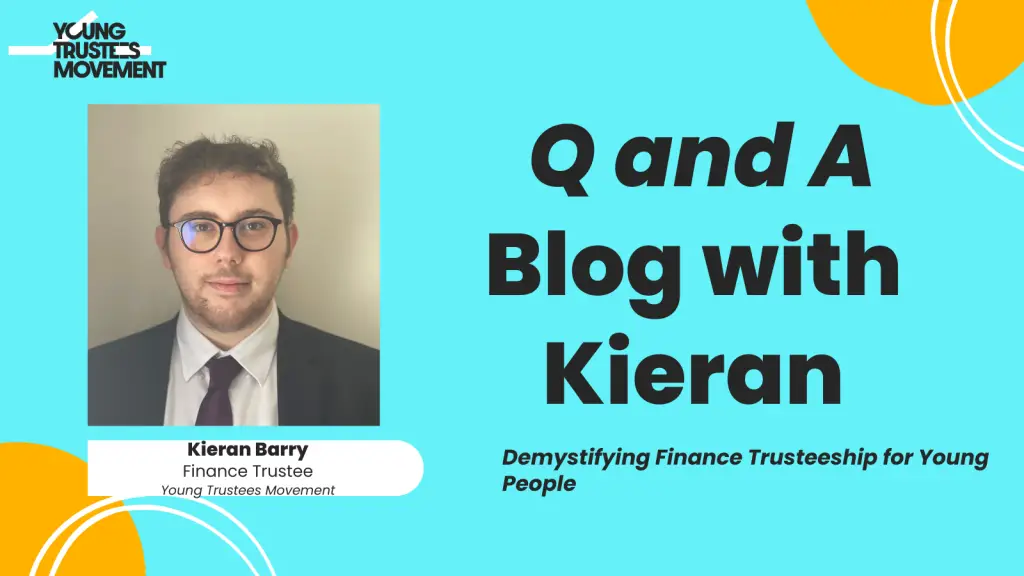
This month, we sat down with Kieran Barry, Finance Trustee at the Young Trustees Movement, to talk about his journey into governance, what the role of a Finance Trustee actually involves, and why young people shouldn’t be afraid to put themselves forward.

In this Q&A, Kieran shares practical advice for aspiring trustees, reflects on the skills organisations are really looking for, and explains how curiosity, a willingness to learn and a passion for good governance can be just as valuable as technical expertise.

Whether you’re considering your first trustee role or simply want to understand finance in governance a little better, we hope you’ll find his insights both encouraging and inspiring.

1. Tell us a little about yourself and your journey into governance.

Hi everyone! I’m Kieran Barry, the new Finance Trustee at the Young Trustees Movement.
I originally started to learn about governance in a very conceptual way when I was at university, studying corporate finance modules. But a lot of my learning came from practical experiences – I got involved in a lot of extracurriculars, including being a President of a society, and being a Part-Time Officer at my Students’ Union. Those gave me some first experiences in weighing up evidence to make strategic decisions, complying with governance documents, and maximising impact given the level of resourcing available. 
It was then that I started in my job at the Financial Conduct Authority, working in a role that included reviewing corporate governance disclosures and practices at many of the biggest companies in the UK. I learned a lot about what good governance looks like from that role (and continue to!), and soon after joined a charity Board as a Treasurer – an experience which was both very much out of my comfort zone, having not had experience as a Trustee before, but also a true privilege and in which I learned a huge amount about being an effective Trustee. Cutting to now, I’m still learning a whole lot at Young Trustees Movement and feel honoured and very excited to be joining the Board!

2. What attracted you to the Finance Trustee role at Young Trustees Movement?

The Young Trustees Movement is, I think, such an important player in the ecosystem of charity governance. As a previous young trustee, I certainly had a lot of moments in which I felt out of place and entirely lacking of experience when I went into rooms with trustees from a range of charities and was the youngest person there.
I think, at a very basic level, young people should absolutely be encouraged to volunteer and learn from being on a Board of a charity whose mission they care about. So, I always really loved what the YTM stood for and continue to see just how important it is to get more young people on charity Boards and provide them the support they need. There’s a lot of enrichment of the sector from the diversity of thought that a variety of ages brings.
The Finance Trustee role in particular called to me as I’d been a Treasurer before and really enjoyed putting my skills and knowledge in finance, accounting, and regulation to use. I genuinely think the role is such an interesting and unique position on a Board and love being able to take on the role of supporting the rest of the Board to understand financial impacts of decisions, and working with leadership teams on effective financial processes and controls. So when I saw the position had opened up at the YTM, I immediately knew I was interested – and a couple of months later, here we are!

3. Many people see a Finance Trustee vacancy and immediately think, “I’m not experienced enough.” What would you say to someone who feels that way?
It’s certainly something I felt when I was looking at Finance Trustee positions, too. It’s very likely that many of the Finance Trustees and Treasurers on charity Boards felt the same way as well. It’s a role that, I feel, is quite misunderstood and looks very intimidating but is so enriching and interesting.
My main advice: you aren’t expected to know everything and have all the answers, or to have a super stacked CV when you go into the role. Many skills and experiences are transferable, and you’re completely encouraged to learn and grow in the role through training out there, and doing a whole lot of research to help answer questions and make informed decisions. Everyone who is in the role was a Finance Trustee for the first time once, and that first role is so important to really understand what the role is about and how to perform it in the best way you can. Think about what skills and knowledge you bring to the table, and remember that the main reason for someone not getting a role is not applying in the first place. So if you’re contemplating it, don’t be afraid to take that leap and step outside of your comfort zone – you’ll be glad that you did!

4. What skills and qualities do you think make a good Finance Trustee?

A few spring to mind as very important:
  • Curiosity – asking the right questions to understand situations affecting the charity and the benefits and drawbacks of different decisions. Not just looking at data, but interrogating it in the right way and connecting it to the bigger picture.
  • Structured strategic thinking – thinking about decisions across the multiple dimensions of how to maximise impact for your charity’s beneficiaries while minimising risk and ensuring that resources are safeguarded.
  • A team player – working effectively with others and leveraging their experiences, and being a ‘critical friend’ to the Board and leadership team, challenging the problem (rather than the person).
  • Clear communication – not speaking in jargon all the time. Much of the role is about communicating the finances in a way that other Trustees with less experience in finances will understand to help them make informed decisions from.
  • Integrity and care for the purposes of the charity – being reliable and trustworthy and willing to lend a hand to support others, and really caring about what the charity does and how to ensure that it delivers the most impact it can.
  • Some understanding of charity finances and regulation is inevitably required – being able to read the numbers, understand trends and patterns in them, communicate them to others alongside any resulting risks, and connect them to the wider environment that the charity operates within. I should note, though, that much of this comes from doing the role!
That’s definitely a non-exhaustive list, but things that I certainly think bring the most value.

5. What do you think people misunderstand most about Finance Trustee roles?

I see two things in particular.
One is that the Finance Trustee is expected to be solely responsible for the finances of the charity. In practice, all the members of the Board legally are. The Finance Trustee is largely there to support the Board in understanding the financial impact of decisions, and to communicate the current financial state of the charity to provide vital context to others. Any decisions around finances are made as a group, not as an individual!
Two is, as I’ve touched on already, that a Finance Trustee is expected to be a successful CFO/senior accountant with a long history of experience and that others need not apply. That absolutely is not true, and shouldn’t put you off applying!

6. How can young people start building the confidence and skills needed for governance roles with financial responsibilities?

By learning, being curious, and looking for opportunities. Some thoughts:
  • At school, college, university, etc, taking on extracurricular roles that put you in a position to learn about leadership, governance, and integrating information around finances into decisions.
  • Looking at and doing training sessions and courses online, many of them free such as with the ICAEW, on finances and accounts for charities, effective governance, and charity regulations and law.
  • Reaching out to existing Finance Trustees to get a sense of what they do as part of their role, and see if they may be able to mentor you or if you may be able to observe what they do.
  • One that I always did: look through charity accounts to get a sense of how the accounts are structured, how policies such as reserves policies are developed and implemented, how risks are determined, how charity audits work, etc. They can be a real wealth of knowledge!

7. What advice would you give to someone applying for their first finance trustee position?

Don’t feel like you have to try to act like you’re an expert in everything finance-related to get the role. Think about what you uniquely bring to the table – whether it be experience as a Treasurer on a university society or at a school club, having observed a Board before or sitting on an Advisory Board, having spent some time in a Finance team at a local business, or generally just having a real interest in how charities are governed and how reporting is done.
Many Finance Trustees out there are open about areas they don’t know, are still learning in their role, and look at ways to develop and fill in the gaps in their knowledge, so communicate that curiosity and willingness to learn. Above all, really think about why you’re applying, both for the charity and the role, and think about how to communicate both your value and passion.

8. What are you most looking forward to contributing as Finance Trustee at Young Trustees Movement?

I think the Movement is at a really exciting period, with a lot going on and a lot of potential for growth, and connecting more and more young people looking for governance opportunities to charities looking for younger Trustees to diversify life experiences and opinions around the Board table. I’m really excited to be getting stuck in and thinking about how the organisation can grow its impact sustainably, make more partnerships across the charity sector, and report on all of the good work it’s doing. I’m also really looking forward to meeting and working with all of the team and learning about new areas in governance from the other Trustees!

9. If you could leave aspiring young trustees with one piece of advice, what would it be?

You’re your own biggest hype person.
Stay curious and keep learning to grow your potential.
Take that leap, even if it feels uncomfortable or nerve-wracking.
Know your value and the unique perspectives and knowledge only you can bring.
Inspired by Kieran’s journey?
Browse the latest trustee opportunities and take the first step towards your own board role here

Free Champion Training

Join a 1 hour training session to understand the power of young trustees, have a framework to understand how to approach board diversity and take practical next steps. New dates are added every month.

Join the Model Boardroom Series

Learn how to think like a trustee and engage with governance, all through exciting mock boardroom scenarios.